
Listening to the Landscape
I was on a call with a mentoring client this week. He’s just signed up to my brand-new Photographer’s Foundations Programme and has come to me with a mind full of questions about the creative process, which I absolutely love and respect. These kinds of people are the ones I love working with the most. When a person has questions, it generally means they are open to learning and, more importantly, to changing and growing; the kind of people the world needs more of.
When I am asked a question about my creative process, I light up. I could talk for hours about the presence, connection, intuition, awareness, and the healing benefits of being out in the natural world. When my client spoke to me about his problems going outdoors in challenging weather, I knew the story I needed to tell and the photograph I needed to share to inspire him to go out and seek stories in all kinds of conditions.
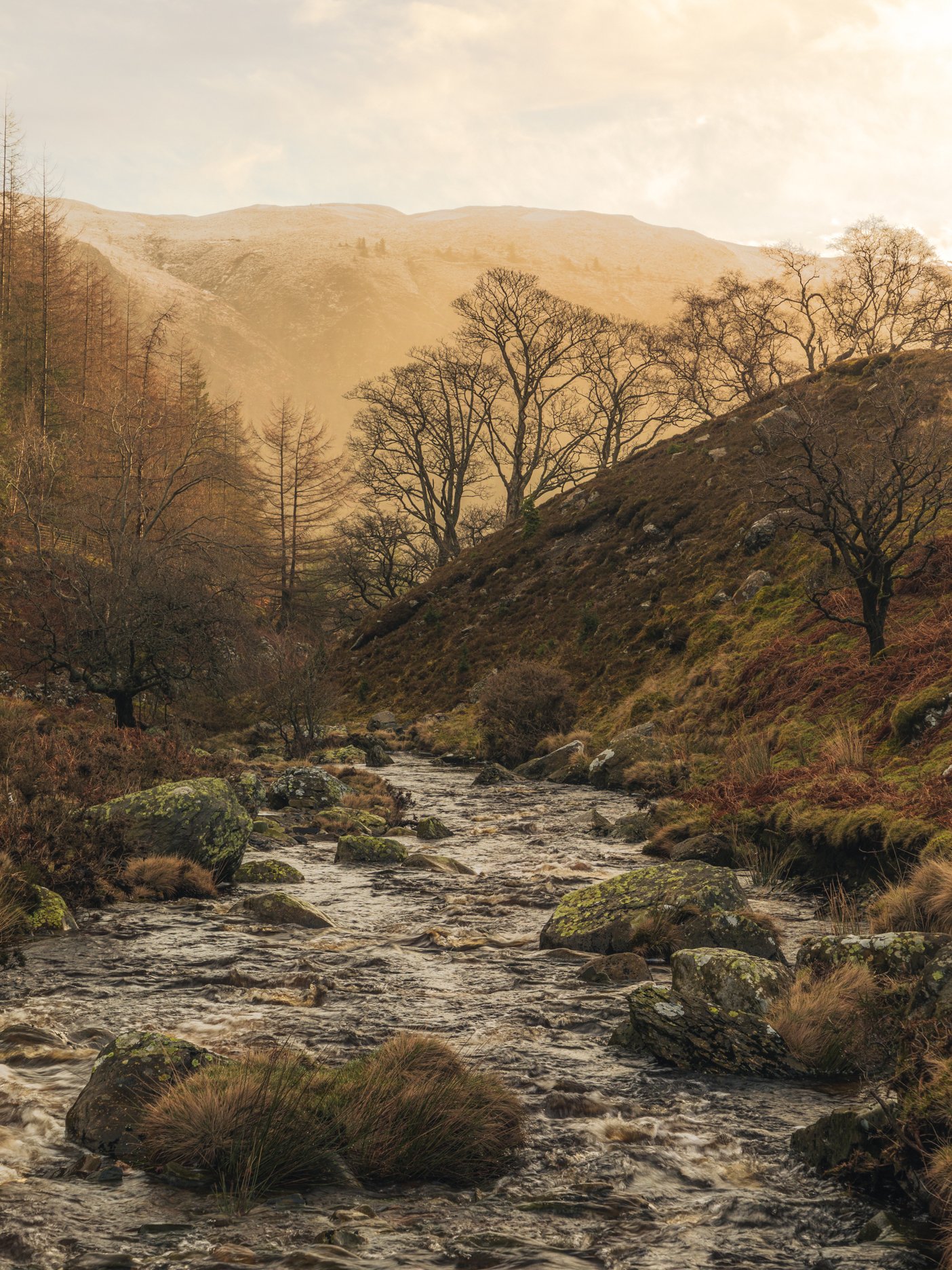
I created Rhiwargor (pictured above) in 2022 after travelling to the Berwyn Mountains, hearing whispers that the snow had fallen on the mountaintops. This was one of those moments I was out in the landscape as it was all unfolding. I’d gone out at first light and set my tripod up in this position with this beautiful stream leading into the mountains in the distance; it had been pretty grey and flat before dawn, and not too much was happening, but as I turned over my shoulder, I could see a front of sleet and snow and rain sweeping in over the mountains behind me. It was the kind of weather front a landscape photographer dreams of, especially during these hours when there is a promise of low light breaking through the clouds.
As the sleet, snow, and rain charged towards me, I’m thinking, ‘I’m gonna get hit right now, but also I’m thinking, more importantly, that this could be really exciting in terms of a photograph because it was coming over my shoulder, and I just knew what could happen if it were to interact with the light as it passed. This is one of the rewards of listening to and reading the landscape.
You eventually get so attuned to your environment when you have spent enough time outdoors searching for photographs, that you know what’s going to happen and when, just like how I knew that this rain and sleet was going to pass over me and fall into that huge landscape bowl which holds the lake at the end of the stream.
I knew intuitively where the light was coming in, I knew where the weather front was heading, and I had already noticed that the clouds were shifting quickly across the sky, which normally means there will be at least one break of sunlight. All I had to do was man my camera and wait it out. The light broke through the clouds and backlit the passing sleet and snow, creating this magical glow in my photograph and implanting a memory in me that will last forever.
Although ‘listening to the landscape’ might sound kind of mystical and difficult to understand in the beginning, it doesn’t need to be. The key is to be present in your surroundings; to look around and observe; to tune into all your senses and attune yourself to the rhythm of the natural world; to listen to the stream enveloping the rocks and cascading its way towards the lake; to pay attention to the clouds and the way in which they dance across the sky; to be ‘here’ in your body and not lost somewhere in your mind.
When we truly learn to be present, we learn the language of the landscape, and seeing the photographs becomes our second nature. We get to a point where we intuitively know where to stand, which way to face, and what compositions will work. We eliminate all thought, and we can respond when the photographs are whispering to us. That is the beauty of learning how to listen to the landscape.
Want to learn how to listen to the landscape? Here are some tips:
Silence your mind. Practice a walking meditation: tune into your breath and draw it deeply into your belly and chest.
Observe your surroundings. Look up at the clouds dancing in the sky. Listen to the cascading river. Smell the fragrances of the peaty soil as you walk. Your senses bring you into the ‘now’.
Learn your style. Be patient with yourself as you begin to understand how you like to use light in your photographs, how you like to compose a scene, and the conditions you like to photograph in. When this becomes intuitive, it’s much easier to be in your body listening to the landscape.
Leave your camera in the bag. In the early stages of photography, we are overwhelmed by choices. Having the camera in hand can add pressure to create. Practice keeping it in the bag until you have listened to the story that wants to be told.
Go out and practice. Go outdoors in all kinds of weather conditions. The more conditions you embrace, the easier it will become to listen to and read the landscape.
If you want to put this into practice and learn more about listening to the landscape, you might benefit from attending one of my Five Pillars group workshops or hiring me for a day of one-to-one tuition. If you’d like to discuss the best pathway for you, you can book a free introductory advice call.